Blog Post #6

For the final blog post, the ethical issue being discussed is how to navigate law and ethics in political reporting. The article is highlights from a conference. Is it okay to re-publish already published classified information? Should journalists receive permission? How does it work? By asking these questions, it fosters a constructive dialogue between the channels.

For the pros, I really liked how they stressed the fact that reporters need to be responsible in what they are reporting on. Politics are a sensitive issue and a lot of lives are involved, meaning the repercussions are very serious for all parties involved, especially with classified information. You never know what the ripple effect will be and how people will be affected. For the cons, I wish the article would have touched more on how to protect these individuals in classified material. Reporters should have bases to follow and areas to protect these individuals, or the news shouldn’t be posted at all. These measures need to be taken in order to protect all parties involved, from the politician to the reporter to the constituents, they all need to be protected and cared for.

Personally, I don’t think it is okay to publish classified information. If it were to be okay, a solution would be receiving permission from the first source and the second source where you found your information. With receiving permission from both forms of sources, you nix any chance of copyright or any problems that could arise from publishing.

https://www.law.upenn.edu/institutes/cerl/conferences/legalethicalchallengesjournalismsecurity/
Blog Post #5

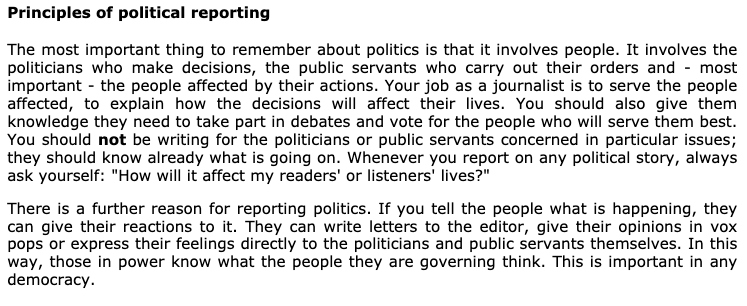
In blog post 5, the ethical issue I will be discussing is the principles of political reporting. When reporting on politics, you are reporting on people are their lives. Whether it be from the candidate, to the people in their lives, to the people of the nation, everyone is effected on this reporting. A journalists job in reporting is to remain ethical and unbiased, to serve the people and communicate the truth to them. If reporters don’t follow through with this commitment, news is falsely spread.

A pro that I found in this article was a question that reporters should ask themselves when sharing news. “How will it affect my readers’ or listeners’ lives?” I thought this was a great thought provoking sentence that really made you think about what you would be publishing. Another pro I found was the outcome that political reporting has. It gives the chance to reach a wide audience and for them to react and share their opinions and beliefs. Without the news, we are lost. I don’t have much of a con for this article. I liked all their points and thought that it was a very thought provoking and pro sided article.

Reporters can’t write in favor of one side, they have to remain neutral. This is hard, especially in politics. As a solution, I find myself reverting back to the question posed at all reporters when reporting. How does it affect others? By doing this, you can ensure your message is being produced clear and loud without any bias.

Blog Post #4

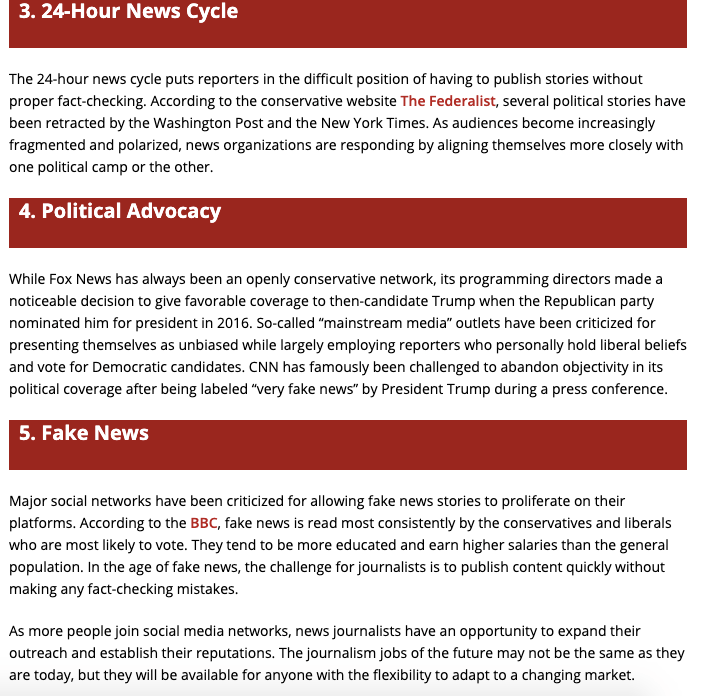
For blog post #4, I found some future challenges for journalists as the world and media world changes. The ethical issue is how the updated media has made it hard for political news to be believed. More specifically, with fake news and the 24-hour news cycle. With news cycling on a constant loop, reporters are put in a difficult position regarding fact checking. According to common reporter rules, your sources should be double checked and verified before publishing the information given. With news cycling so fast, news reporters don’t always fact check in hopes to get their news out first and be the breaking story.

In political news, news stations tend to align themselves with one political area or the other. Fox for example, is a conservative network. The issue with news stations aligning themselves is that news stations are supposed to serve as unbiased and informing the public. However, they take a biased stance on politics when they show and align with one side or the other. Therefore, information published by that source would be hard to believe. Fake news is essentially the same with fact checking. The news stations are publishing what they hear and taking it as word, without checking properly. In the book assigned for class, they mention how fack checking on reporting can’t be something that is bypassed because of the potential backlash you are leaving open for when they article is released.

A con of this is that the public could be receiving false accounts of news and further spreading it. Let’s say you only watch Fox, but you didn’t know about their political alignments. You watch Fox for news updates, but you will only hear the sides that make the conservative party look good, a bias reporting. This is a huge downside in the correct way of reporting ethically. For a pro, if people know of the bias in a news station, they can boycott that station and spread the truth. To form a solution, news stations should be help to a higher account when it comes to their fact checking and reporting on biased news.

Blog Post #3

The ethical issue discussed in the article I chose for blog post #3 is how news stations and reporters keep an ethical base in spite of the changing times in the media. There has been a dramatic decline in news journalism as technology has changed the way news is received and resonated. Because of this change, media is produced faster and given to the public even faster. News is constantly rotating, and with politicians being able to produce their own content via social media, news stations have to stay on top of the game and produce the news before other outlets, sometimes causing improper distribution of information.

For pros, I found that the creation of the Ethical Journalism Network was founded due to this growing of media coverage. This network was created to strengthen journalism in the face of a crisis and keep reporters honest. It eliminates, or further reduces, the chances of bad ethical reporting, especially regarding politics.

A con for how news is given to the public now is that there are news channels that have popped up that have made their fortune on exploiting personal data and violating common ethical bases. Everyone believes what they read online, creating a basis for fake news to spread fast. Finally, I think a good solution is to build public trust and further stress the importance of ethical reporting in the political realm.

Lastly, a solution. I offer the solution of fact checking in more extreme measures. It may take longer and I know that isn’t always an option, but it would help the reporters and news stations out more in the long run if they know that they information they are producing is 100% correct.

https://en.unesco.org/courier/july-september-2017/ethical-journalism-back-news

Blog Post #2

For my second blog post, I will be discussing the New York Times regulations regarding ethical issues in reporting when it comes to family ties. The ethical issue discussed is that “any staff member who sees a potential for conflict or a threat to the paper’s reputation with his or her supervising editor and the standards editor or the deputy editorial page editor.” This means that if you are a reporter for the times and you have information that was given to you through family ties and it could potentially harm the paper, you must report it. It can also mean that the Times has the option, after disclosing, to withdraw the reporter may have to withdraw, transfer departments or have assignments modified, depending on the extent of the conflict.

The guidelines say that the Times has no wish to intrude into the lives of their staff members and families, which I see as a pro in this issue. For as much as they try to protect their reputation, they do try and keep their staff members away from conflict. As a con, they are putting their staff members in a complicated position because if they have to, they are making their people chose between a work life and their family ties. I think that the Times puts to much pressure in this clause on its employees to judge what needs to be disclosed and what doesn’t. Without strong guidelines to follow to prevent any ethical conflicts, it is hard to determine what is considered bad to the paper.

As a solution, the paper should publish a vague list of things that would fall under need to be disclosed and what not. This would prevent any miscommunication and would establish a strong repore between the paper and staff members. Attached below, you will find the link to the article I am discussing.

https://www.nytimes.com/editorial-standards/ethical-journalism.html#sortingOutFamilyTies

Blog Post #1

Staying Neutral – A Challenge

The issue of staying neutral or unbiased described in the article I chose is relevant to my topic in the aspect of reporting. Reporting on political news is a challenge because you want to report a factual basis yet keep your own opinions neutral. However, in politics, it is often hard to remain neutral because there is rarely a decided winner. This is the first challenge that I will tackle in discussing political reporting.

The ethical issue of this article is about remaining neutral while reporting on political news. The article states that while it is a challenge to remain neutral and unbiased when reporting political events, it is even more of challenge when reporting on political debates. Unlike when reporting on other events, political debates don’t have a clear winner to report on. It is instead up to the journalist to communicate to the public who made the best argument and which moments mattered most, using their own determinations about the debate to report what happened. With debates and most political events lasting well beyond a few hours, it makes it hard for the public to stay tuned in and watching, so informing the public on what happened lies with the journalist. Everyone has different views and opinions so it is important to stay neutral to deliver a clear picture of what happened.

A pro of staying neutral when reporting on news is that you will reach a wider audience. Most news stations, no matter how hard they try not to, tend to favor a certain side or belief system. My solution to the problem at hand, based on the article, is to stick to the general facts and keep wording as neutral as possible. If the main points and arguments are highlighted in an informative way, it eliminates the potential for bias. Keeping the content strict and informative with little room for discussion will further the neutrality of the reporter.

https://www.washingtonpost.com/opinions/2019/06/26/reporters-want-seem-neutral-thats-impossible-political-debate-coverage/

Topic Introduction

Ethical Issues in Reporting Political News

Through the semester, SIX or more posts need to be completed in order to receive an A. A blog post can be an article, photo or video that talks about the ethical issue that I selected for my blog topic. Each post should have commentary on the chosen media regarding the topic. The blog must discuss 1) the ethical conflict, 2) what the pros and cons are, and 3) what you think the solution is.

The posts should refer back to the discussion of the issue in the text, including specific page citations. Essentially, tie main points in each blog post back to information that was read in the text. Each post should be at least 250 words long.

Design a site like this with WordPress.com
Get started